In-Utero Twin Absorption
The Dark HalfIn-Utero Twin Absorption is the incomplete prenatal absorption of one twin by another, which leaves tissue from Thad Beaumont’s twin entwined with the developing brain of the surviving child. The concept joins a rare medical explanation to the supernatural conflict at the novel’s center: the residual tissue grows again in childhood, while Alan Pangborn comes to understand Thad and George Stark as bound by a history that began before either could choose it.
Medical Discovery and Explanation
Dr. Pritchard explains that Thad’s childhood problems were caused by a small mass in the prefrontal lobe. The doctors operated under the assumption that it was a tumor, but the mass proved to be Thad’s twin. Pritchard presents the discovery as unusual in degree rather than wholly unprecedented: twins are often absorbed in utero, he says, but incomplete absorption is rare, and the growth of the remaining tissue was also unusual.
The tissue had initially remained inert. Pritchard suggests that it became active when Thad was about eleven, perhaps in connection with the early onset of puberty, and began to grow. Because there was no room for it in the brain, it had to be removed surgically. His matter-of-fact account treats the operation as successful, but the discovery retrospectively makes Thad’s childhood surgery more than the removal of an ordinary tumor: the mass was a surviving remnant of a twin.
What the Absorption Means
Pritchard is careful to distinguish absorption from an act of deliberate violence. He describes two early masses of tissue, one larger and stronger than the other, with the stronger incorporating the weaker through a biological process whose cause remains unknown. He speculates that a signal connected to the mother’s endocrine system might have triggered it, but offers this as a possibility, not a demonstrated explanation. At that stage, he adds, the tissue may not yet have been recognizably human in form.
The absorption was not complete. A portion of the other twin retained its integrity and became intertwined with the tissue that formed Thad’s brain. That remainder is the essential distinction between an absorption that leaves no apparent trace and Thad’s case: the absorbed twin’s tissue persisted, later became active, and was surgically excised. Pritchard believes the twin was probably Thad’s brother, reasoning from the relative rarity of absorption among fraternal twins and the fact that identical twins are always the same sex. He explicitly qualifies this as a statistical inference rather than a certainty; the surviving twin could have been a sister.
Connection to George Stark
When Stark is present at the Beaumont family’s summer house, he describes himself as needing a kind of transfusion from Thad. He believes Thad can restore something in him because, as he puts it, Thad cloned much of his equipment from his own. The explanation is Stark’s, not an established medical account of the absorption. Alan rejects Stark’s claim that Thad alone created him and instead thinks of Stark as the ghost of Thad’s dead brother, while also recognizing that this description cannot contain the full nature of their connection.
Stark connects the twins’ history to the next generation. He says that he came into being after the deaths of the twins who would have been William and Wendy’s older siblings, and calls this a kind of transcendental balancing act. His account links the prenatal twin absorption to a recurring pattern of twins and losses, but it does not establish a literal biological mechanism by which those later deaths caused his existence. Stark himself acknowledges the explanation’s apparent irrationality, then insists on the fact of his presence.
Identity and Narrative Significance
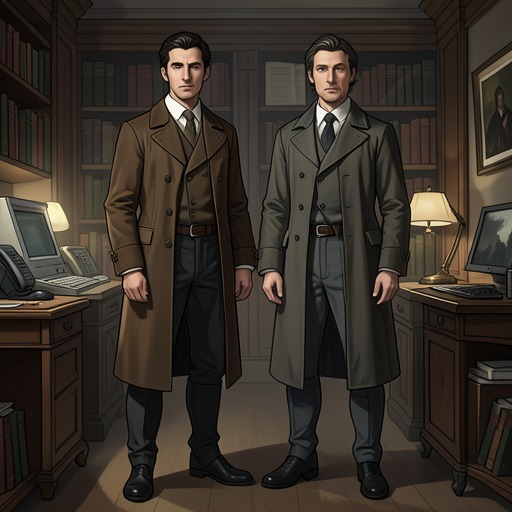
Pritchard’s revelation changes the terms in which Alan understands Thad. After hearing that Thad once absorbed a twin, Alan thinks of him as having always been two men: the person who inhabits the ordinary world and the person who creates worlds. This is Alan’s interpretation, not Pritchard’s medical conclusion. It makes the surviving twin tissue a bridge between physical history and the novel’s struggle over authorship, identity, and the boundary between creator and created.
The concept also leaves an important uncertainty intact. Pritchard can identify the childhood mass as tissue from Thad’s twin and explain why it was removed, but he cannot account for the full supernatural relationship between Thad and Stark. Stark offers his own account of being made from Thad, while Alan imagines a dead brother’s presence that exceeds any simple diagnosis. In-Utero Twin Absorption therefore supplies a concrete origin for the story’s divided-self imagery without reducing Stark’s existence to a medical fact.